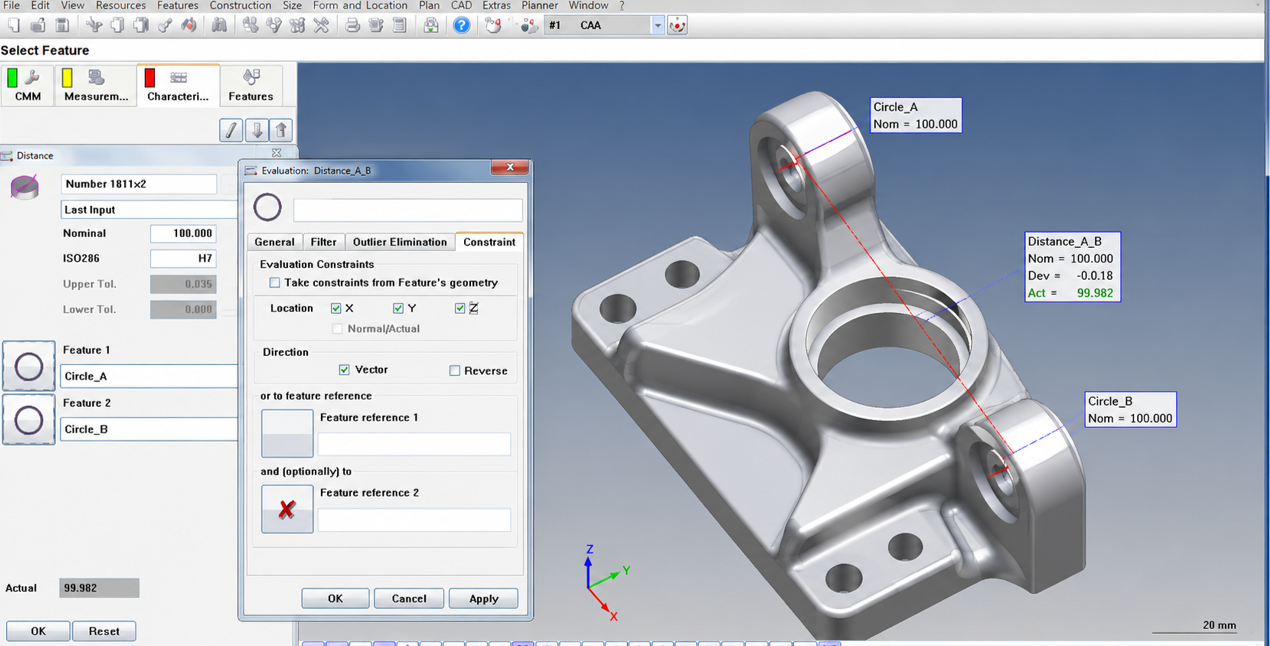

ZEISS CALYPSO 2020 vs 2023: Features, GD&T Improvements and Key Differences
Choosing the right version of ZEISS CALYPSO can have a significant impact on CMM programming workflows, measurement evaluation and quality reporting.
CALYPSO 2020 (Version 7.0) and CALYPSO 2023 (Version 7.6) introduced different improvements to dimensional measurement and inspection processes. While CALYPSO 2020 expanded programming, reporting and measurement-plan capabilities, CALYPSO 2023 placed greater emphasis on automated fault analysis, GD&T evaluation and optical CMM workflows.
This article compares the two versions based on documented features and practical considerations for CMM programmers, quality engineers and manufacturers.
1. Overview of ZEISS CALYPSO 2020 and 2023
ZEISS CALYPSO is a measurement software platform used for dimensional inspection with compatible ZEISS coordinate measuring machines and optical measurement systems.
Both versions support established CMM programming and measurement workflows. However, their release highlights reflect different development priorities.
CALYPSO 2020 – Version 7.0
CALYPSO 2020 introduced improvements in programming efficiency, measurement strategies, CAD-related workflows and reporting.
Documented features include:
- Cookbook measurement strategy.
- Strategy allocator with ZEISS standards.
- Measurement-plan comparison, including copying, merging and deleting elements.
- Improved search functionality.
- Improvements to CALYPSO Curve and PCM commands.
- PiWeb reporting enhancements, including faster report and PDF creation.
- Improvements to PMI workflows and selected GD&T-related functions.
- Additional optical measurement and point-cloud capabilities.
CALYPSO 2023 – Version 7.6
CALYPSO 2023 focused on performance-related improvements, including:
- Improved automated fault analysis.
- Interactive reports displaying detected faults.
- Improved automated plots and dynamic zooming.
- Advanced GD&T evaluation algorithms according to ISO-GPS and ASME.
- New evaluation functionalities for optical CMM workflows, including ZEISS O-DETECT.
- Overview camera navigation and automatic search for geometric elements in acquired images.
- A customizable toolbox for frequently used measurement features.
These features are documented in ZEISS release information and its May 2023 press release.
2. ZEISS CALYPSO 2020 vs 2023: Feature Comparison
The following table highlights the documented differences between the two releases.
| Feature | CALYPSO 2020 (7.0) | CALYPSO 2023 (7.6) |
|---|---|---|
| Programming workflow | Improvements to measurement strategies and plan editing | Improved usability and customizable toolbox |
| Measurement strategies | Cookbook and strategy allocator | Workflow improvements |
| Measurement plan management | Compare, copy, merge and delete plan elements | No equivalent feature highlighted in the cited 2023 announcement |
| GD&T evaluation | Selected PMI and GD&T-related enhancements | Improved evaluation algorithms for ISO-GPS and ASME |
| Fault analysis | Existing measurement evaluation workflows | Improved automated fault analysis |
| Reporting | PiWeb reporting and PDF-generation improvements | Interactive fault reports and improved plots |
| Optical CMM | O-INSPECT and optical workflow improvements | Additional evaluation functions for systems such as O-DETECT |
| CAD and measurement data | CAD, PMI and point-cloud improvements | Focus on improved evaluation and usability |
| PCM and curve | New PCM commands and CALYPSO Curve enhancements | No broad PCM upgrade claim made here |
Important: This is a comparison of documented release highlights, not a complete list of every function, license option or hardware compatibility difference. The availability of individual functions depends on the installed options, machine configuration and software environment.
3. What Changed in CALYPSO 2020?
CALYPSO 2020 introduced several improvements that are relevant to everyday CMM programming.
3.1 Cookbook Measurement Strategy
The Cookbook strategy provides a way to work with predefined measurement strategies.
For CMM programmers, standardized strategies can help make programming more consistent and reduce repetitive setup work.
The actual benefit depends on how measurement strategies are configured and used in the inspection process.
3.2 Strategy Allocator
The Strategy Allocator with ZEISS standards provides additional support for selecting measurement strategies.
This can be useful when developing inspection plans for different geometric features and measurement requirements.
3.3 Measurement Plan Comparison
One useful CALYPSO 2020 feature is the ability to compare measurement plans and copy, merge or delete plan elements.
This is particularly relevant when:
- Updating an existing inspection program.
- Creating a new program based on a previous project.
- Comparing revisions of a measurement plan.
- Reusing selected measurement characteristics.
For manufacturers handling many part revisions, these capabilities can help organize programming changes.
3.4 PiWeb Reporting Improvements
CALYPSO 2020 also introduced improvements to PiWeb reporting.
The release documentation includes faster report creation and PDF generation, along with additional reporting and data-management functions.
These improvements are useful for quality departments that regularly generate inspection reports and manage measurement results.
4. What Changed in CALYPSO 2023?
CALYPSO 2023 introduced several improvements that are especially relevant to measurement evaluation and fault analysis.
4.1 Improved GD&T Evaluation
ZEISS announced improved algorithms for GD&T evaluation according to standards such as ISO-GPS and ASME.
This is important for applications involving:
- Position tolerances.
- Profile tolerances.
- Datum reference systems.
- Geometric evaluation and reporting.
However, users should not assume that changing the CALYPSO version automatically guarantees different or more accurate measurement results.
GD&T results still depend on the drawing requirements, selected evaluation method, datum setup, measurement strategy, machine condition and applicable software options.
4.2 Improved Automated Fault Analysis
One of the main highlights of CALYPSO 2023 is improved automated fault analysis.
According to ZEISS, detected faults can be displayed automatically in an interactive report.
Improved automated plots and dynamic zooming also help users inspect measurement deviations in greater detail.
This can be particularly useful when analyzing small mechanical components and electronic devices.
4.3 Improved Optical CMM Workflows
CALYPSO 2023 introduced additional evaluation functions for optical CMM systems such as ZEISS O-DETECT.
Examples include:
- Using the overview camera for navigation.
- Automatically searching for geometric elements in acquired images.
These functions are particularly relevant to manufacturers using optical measurement workflows.
They should not be interpreted as universal improvements to every tactile CMM configuration.
4.4 Customizable Toolbox
CALYPSO 2023 also introduced usability improvements.
Frequently used measurement features can be stored as favorites in an individual toolbox.
This allows users to customize their working environment and reduce the number of steps needed to access commonly used functions.
5. Practical Considerations for CMM Programmers
Software release notes explain what has changed, but they do not always explain how those changes affect daily inspection work.
When comparing CALYPSO 2020 and 2023, CMM programmers should also consider the following practical issues.
5.1 Existing Measurement Plans
Before upgrading, review existing measurement plans and identify the programs that are critical to production.
Check:
- CAD model compatibility.
- Existing alignments and datum definitions.
- Probe and stylus configurations.
- Measurement strategies.
- PCM commands and external data connections.
- Reporting templates and output formats.
Do not assume that every program will produce identical results after a software upgrade.
5.2 Probe Qualification and Measurement Strategy
Probe qualification is an essential part of a reliable CMM measurement process.
After changing software versions, machine configurations or probe components, verify that the probe system is correctly configured and qualified.
For small holes, deep features and tight tolerances, review the stylus diameter, approach direction, clearance distance, retract movement and measurement speed.
A software upgrade does not replace the need for a safe and validated measurement strategy.
5.3 GD&T Result Verification
When comparing measurement results between versions, use a controlled verification process.
For example, a part with a position tolerance or profile tolerance should be evaluated using the same:
- Drawing revision.
- Datum reference system.
- Measurement points or scanning strategy.
- Evaluation settings.
- Relevant standard and tolerance definition.
Compare the resulting values and reports carefully before accepting a new software configuration for production.
5.4 Reporting and PiWeb Compatibility
If your inspection process uses customized PiWeb reports, check the report templates, characteristic mapping, output settings and database connections before upgrading.
A report that looks different does not necessarily indicate a change in the actual measurement result.
6. Should You Upgrade from CALYPSO 2020 to 2023?
The decision depends on your machine configuration, software license, production requirements and the features you need.
CALYPSO 2020 may remain suitable when:
- Your current measurement programs are stable.
- Your machine and software configuration are validated.
- Your reporting workflow meets production requirements.
- You do not need the specific improvements introduced in later releases.
CALYPSO 2023 may be worth evaluating when:
- You need improved automated fault analysis.
- Interactive reports and improved plots are useful for your inspection process.
- You work with GD&T evaluations according to ISO-GPS or ASME.
- You use compatible optical CMM systems and can benefit from the additional evaluation functions.
- The new toolbox and usability improvements fit your workflow.
An upgrade should be evaluated against the actual machine, license and software environment rather than based only on the release year.
7. Important: ZEISS CALYPSO Software Lifecycle
Software lifecycle information is an important consideration when selecting a version for long-term production use.
According to the ZEISS Software Product Discontinuation information:
| Version | End of Sales | End of Support |
|---|---|---|
| CALYPSO 2020 (7.0) | 18 May 2022 | 05 May 2023 |
| CALYPSO 2021 (7.2) | 05 May 2023 | 02 May 2024 |
| CALYPSO 2022 (7.4) | 15 June 2024 | 05 May 2025 |
| CALYPSO 2023 (7.6) | 05 May 2025 | 04 November 2026 |
| CALYPSO 2024 (7.8) | 04 November 2026 | Not listed |
As of November 2026, the published end-of-support date for CALYPSO 2023 has passed.
ZEISS explains that end of support means hotline services and support are no longer provided for the listed software versions and their previous revisions.
This does not automatically mean that an installed version stops working. However, companies should consider the implications for maintenance, troubleshooting and long-term production support.
ZEISS also publishes a separate licensing announcement concerning Flexera and Wibu licensing, with license support scheduled to end on 31 May 2030. The announcement advises using versions with THALES licensing, which ZEISS identifies with releases from 2024 onward. Check your specific license and machine configuration with ZEISS before making a migration decision.
8. Our Recommendation: Choose Based on Your Measurement Requirements
There is no single CALYPSO version that is automatically the best choice for every CMM application.
A stable and validated measurement process is more important than simply using the newest available software.
Before upgrading, consider:
- Which CALYPSO version is currently installed?
- Which CMM model and controller are being used?
- Are existing measurement programs compatible?
- Are there specific GD&T or reporting functions that require improvement?
- Does the current license support the intended upgrade?
- Can the new environment be validated before production use?
For companies with established inspection programs, a controlled migration and verification process is recommended.
9. HP METROLOGY: CMM Programming and Measurement Support
HP METROLOGY provides technical support for manufacturers and quality engineers working with CMM measurement processes.
Our services include:
- ZEISS CALYPSO CMM programming.
- Remote CMM programming support.
- Measurement plan development and optimization.
- GD&T evaluation support.
- Inspection report review and analysis.
- CMM measurement strategy consulting.
- Online and onsite technical training.
Whether you are maintaining an existing CALYPSO program, developing a new inspection plan or reviewing measurement results, HP METROLOGY can help you improve your measurement workflow.
Need support with a ZEISS CALYPSO project?
Send us your technical drawing, 3D CAD model, existing measurement plan or inspection requirements.
We can review your requirements and discuss a suitable technical solution.
Website: https://hpmetrology.com/
Frequently Asked Questions
1. What is the main difference between ZEISS CALYPSO 2020 and 2023?
CALYPSO 2020 introduced improvements in measurement strategies, measurement-plan management and PiWeb reporting. CALYPSO 2023 focused more on automated fault analysis, GD&T evaluation, optical CMM workflows and usability.
2. Does CALYPSO 2023 provide better GD&T evaluation?
ZEISS announced improved GD&T evaluation algorithms according to ISO-GPS and ASME in CALYPSO 2023. Actual results still depend on the measurement strategy, datum system, evaluation settings and applicable standards.
3. Can I continue using CALYPSO 2020?
An existing installation may continue to operate, depending on its license, hardware and system configuration. However, ZEISS lists 05 May 2023 as the end-of-support date for CALYPSO 2020. Companies should assess their maintenance and production risks.
4. Is upgrading from CALYPSO 2020 to 2023 always necessary?
No. An upgrade should be based on specific technical requirements, software compatibility, license availability and the benefits expected from the new functions.
5. Does upgrading CALYPSO automatically improve CMM measurement accuracy?
No. Measurement accuracy depends on the CMM, calibration, environmental conditions, probe qualification, measurement strategy, workpiece setup and evaluation method. Software improvements alone do not guarantee higher measurement accuracy.
6. Can HP METROLOGY help with remote CALYPSO programming?
Yes. HP METROLOGY offers remote CMM programming and technical support for suitable projects. Customers can provide technical drawings, CAD models and inspection requirements for an initial review.
References
- ZEISS – Software Product Discontinuation
- ZEISS – Higher Flexibility with Less Effort: CALYPSO 2023
- ZEISS – CALYPSO 2020 Release Information, Version 7.0.00
- ZEISS – Latest CALYPSO Release Notes
This article is an independent technical comparison based on publicly available ZEISS documentation. HP METROLOGY is not affiliated with or endorsed by ZEISS.
Leave a Reply